
Engineering Repeatability and Accuracy into Medical Device Actuation

Engineering Repeatability and Accuracy into Medical Device Actuation
A Growing Challenge in Medical Device Design
As medical devices become more automated, compact and data-driven, the demands placed on actuation systems are changing. Precision is no longer just about achieving the correct movement, it is about achieving that movement consistently, predictably and repeatedly over millions of cycles.
In applications such as precision dispensing, diagnostic imaging and minimally invasive systems, small variations in actuation affect performance and ultimately patient outcomes. As a result, repeatability and accuracy are becoming defining requirements in modern medical device engineering.
Why Actuation Is Under Increasing Scrutiny
The shift towards miniaturisation and system integration is placing new constraints on component design. Actuators must now operate within tighter spaces, with lower power consumption and greater reliability, while maintaining exact control.
This is particularly evident in areas such as fluid handling and imaging. Precision dispensing systems rely on repeatable valve behaviour to ensure accurate dosing, while shutter control mechanisms must operate with exact timing and positioning to maintain image integrity. At the same time, locking and quick-change systems must deliver consistent performance without degradation, even in high-cycle environments.
The Role of Electromagnetic Technologies
Electromagnetic actuation is increasingly well suited to these evolving requirements, offering a combination of controllability and durability.
Components such as mini pneumatic cartridge valves support highly accurate control in compact systems, while proportional solenoid valves enable stable, repeatable modulation of flow and pressure. Rotary solenoids provide controlled angular movement for applications like shutter systems, where consistency is critical.
In more demanding environments, encapsulated linear solenoids offer protection against contaminants and cleaning processes, ensuring performance remains stable over time. Across these technologies, the common thread remains the ability to deliver predictable, repeatable actuation, regardless of the operating conditions.
Supporting Repeatability in Practice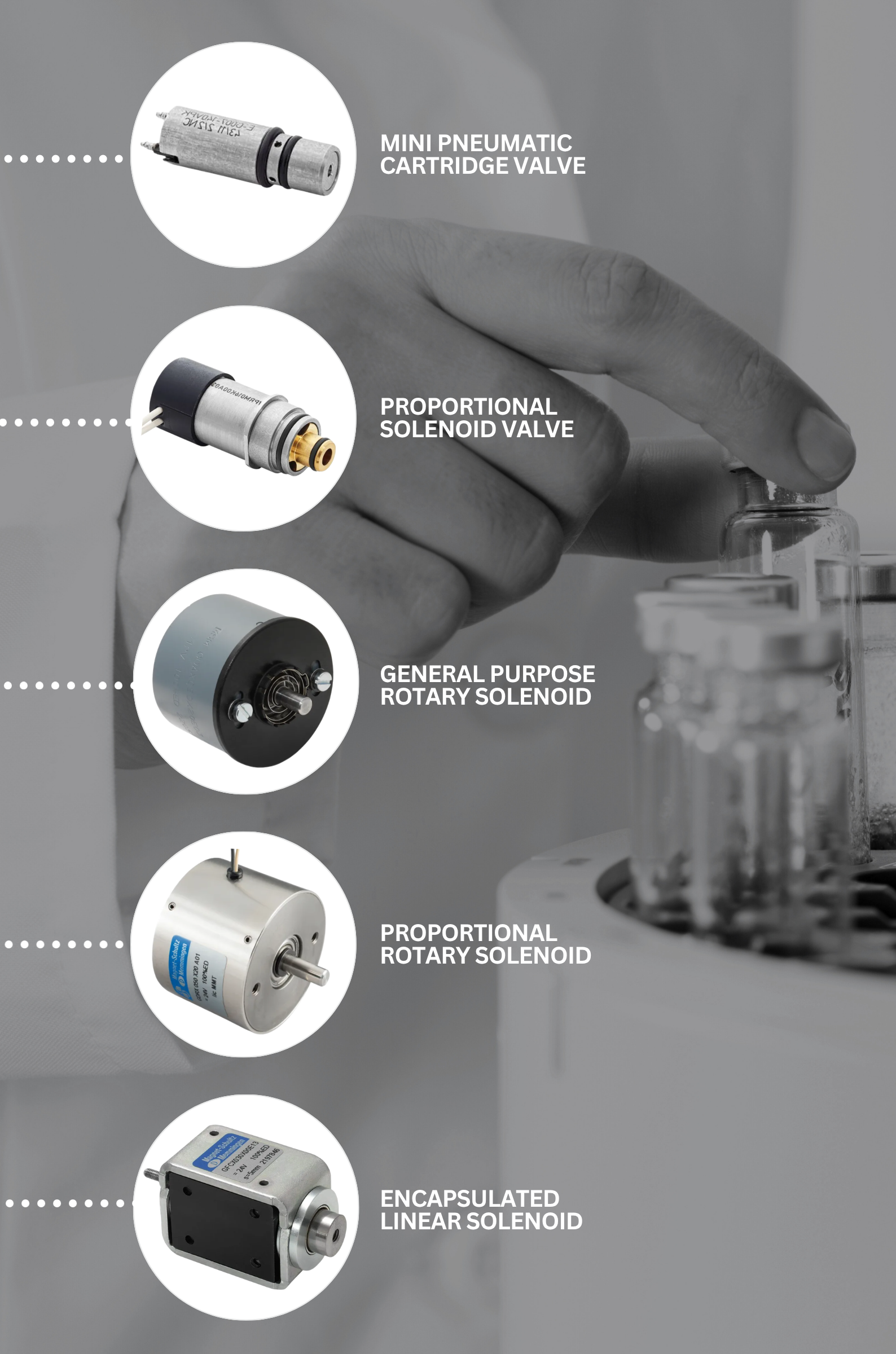
At Magnet Schultz, these principles are applied throughout the development of application-specific solutions designed for medical and pharmaceutical environments.
For precision dispensing systems, mini pneumatic cartridge valves and proportional solenoid valves enable accurate, repeatable control of fluid delivery. In imaging and diagnostic equipment, rotary solenoids support consistent shutter control, ensuring reliable timing and positioning.
Locking mechanisms and quick-change systems are designed for secure, repeatable engagement, even under high cycle conditions. Where environmental protection is required, encapsulated linear solenoids ensure long-term stability in the presence of fluids or contaminants.
Rather than relying on standard components, solutions are often tailored to meet specific requirements around size, force, lifecycle and integration, ensuring repeatability and accuracy are engineered into the system.
Designing for Repeatability, Not Just Function
What is becoming increasingly clear is the importance of actuation in medical devices exceeding basic functionality. Now, the requirement is engineered systems that behave identically over time, across environments and throughout the product lifecycle.
This requires careful consideration of materials, tolerances and control characteristics, as well as a willingness to move beyond standard components where needed.
Looking Ahead
As the medical sector continues to advance, the importance of repeatable and accurate actuation will only grow. Greater automation, increased regulatory scrutiny and the continued push for miniaturisation will all reinforce the need for components that deliver consistent performance without compromise.
In this context, actuation is not a background function but a crucial enabler of device performance, reliability and patient safety.
 sales@magnetschultz.co.uk
 +44 (0)1483 794700